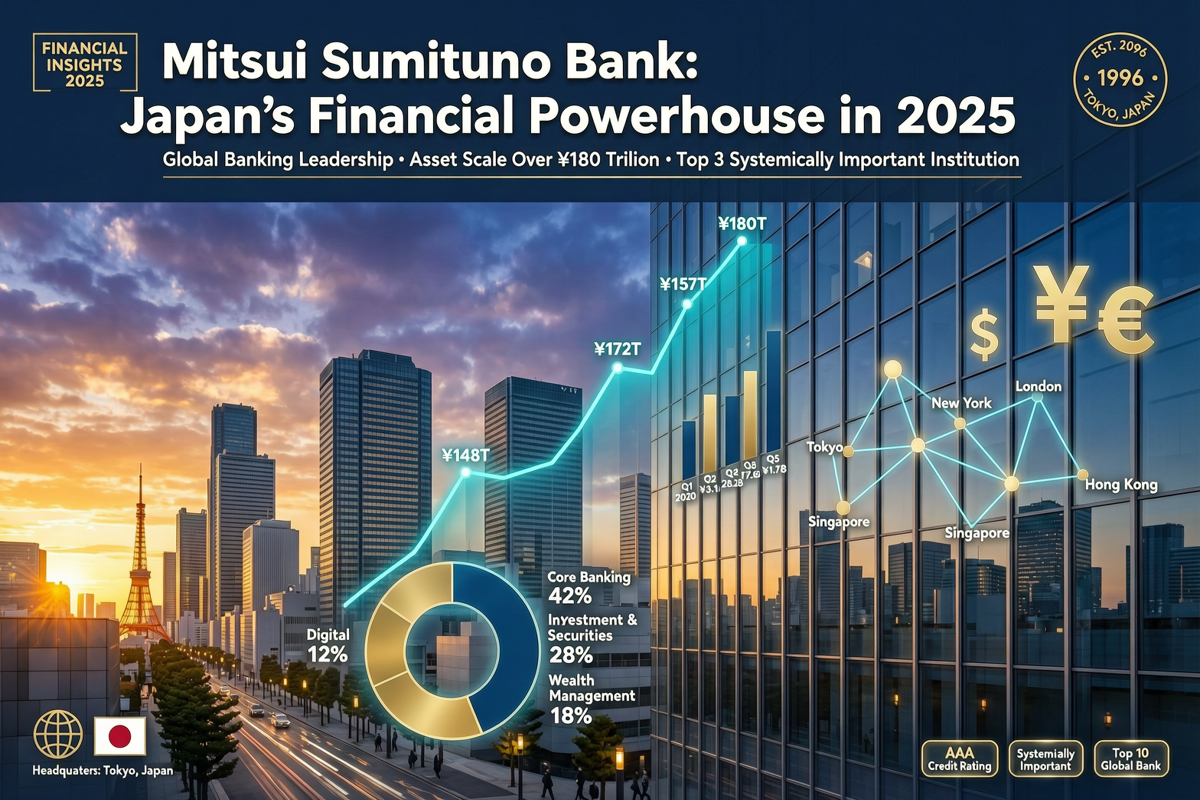
Mitsui Sumitomo Bank: Japan's Financial Powerhouse in 2025
Explore how Mitsui Sumitomo Bank is leveraging digital innovation, sustainable finance, and global expansion to redefine banking in 2025 and beyond.
Introduction: A Legacy of Stability and Innovation
Mitsui Sumitomo Bank (SMBC) stands as one of Japan's most prestigious financial institutions, with roots tracing back to the 17th century. As part of Sumitomo Mitsui Financial Group (SMFG), the bank has consistently evolved to meet the changing demands of the global economy. In 2025, SMBC is not just a custodian of tradition but a forward-thinking player embracing digital transformation, sustainable finance, and strategic global expansion. This article delves into the bank's current strategies, key initiatives, and what makes it a cornerstone of Japan's banking sector.
Digital Transformation: Redefining Customer Experience
In recent years, SMBC has invested heavily in digital banking to enhance customer convenience and operational efficiency. The bank's mobile app, SMBC Direct, now offers AI-powered financial planning tools, real-time spending analytics, and seamless integration with Japan's cashless payment ecosystem. In 2025, SMBC launched a fully digital onboarding process for new accounts, reducing paperwork and approval times from days to minutes. The bank also partnered with fintech startups to offer personalized lending products and investment advice, leveraging machine learning to assess credit risk and market trends.
Open Banking and API Integration
SMBC has embraced open banking, allowing third-party developers to build applications that connect securely with customer accounts. This initiative has spawned innovative services like budgeting apps that automatically categorize transactions and savings goals based on spending patterns. The bank's API platform now supports over 200 financial service providers, fostering a vibrant ecosystem that benefits both consumers and businesses.
Sustainable Finance: Leading Japan's Green Transition
As environmental concerns mount, SMBC has positioned itself as a leader in sustainable finance. The bank committed to achieving net-zero greenhouse gas emissions from its lending and investment portfolios by 2050. In 2025, SMBC expanded its green bond offerings, raising over $5 billion for renewable energy projects, including offshore wind farms in Hokkaido and solar installations in Kyushu. The bank also introduced sustainability-linked loans for corporations, offering lower interest rates to borrowers meeting predefined environmental targets.
ESG Integration in Investment Banking
SMBC's investment banking division now incorporates Environmental, Social, and Governance (ESG) criteria into all advisory and underwriting services. The bank declined to finance several coal-fired power plant projects, instead channeling capital into green infrastructure. This approach has attracted ESG-focused institutional investors, strengthening SMBC's reputation as a responsible financial partner.
Global Expansion: Strengthening International Presence
While deeply rooted in Japan, SMBC has aggressively expanded its global footprint. The bank operates in over 40 countries, with a strong presence in Asia, North America, and Europe. In 2025, SMBC opened new branches in Vietnam and India to tap into rapidly growing economies. The bank also acquired a minority stake in a U.S.-based fintech specializing in cross-border payments, enhancing its ability to serve multinational corporations.
Focus on ASEAN and India
SMBC views Southeast Asia and India as key growth markets. The bank's regional strategy includes offering trade finance, project finance, and treasury services to local companies and Japanese subsidiaries. In India, SMBC partnered with a leading digital lender to provide small business loans, leveraging the partner's technology to reach underserved segments.
Risk Management and Regulatory Compliance
In an era of heightened regulatory scrutiny, SMBC maintains robust risk management frameworks. The bank's advanced analytics team uses AI to monitor transactions for money laundering and fraud, reducing false positives by 30% compared to traditional methods. SMBC also adheres to Basel III capital requirements, maintaining a common equity tier 1 (CET1) ratio well above regulatory minimums. This prudent approach ensures stability even during economic downturns.
Future Outlook: Embracing AI and Beyond
Looking ahead, SMBC plans to integrate generative AI into customer service, using chatbots to handle complex queries and provide personalized financial advice. The bank is also exploring blockchain for trade finance, aiming to reduce processing times from days to hours. With a strong capital base and a culture of innovation, Mitsui Sumitomo Bank is well-positioned to navigate the challenges and opportunities of 2025 and beyond.
Conclusion
Mitsui Sumitomo Bank exemplifies how a traditional institution can reinvent itself for the modern era. By prioritizing digital innovation, sustainable finance, and global expansion, SMBC continues to serve its customers while contributing to a more resilient and inclusive financial system. As the banking landscape evolves, SMBC's commitment to excellence and adaptability ensures it remains a trusted partner for individuals, businesses, and communities worldwide.