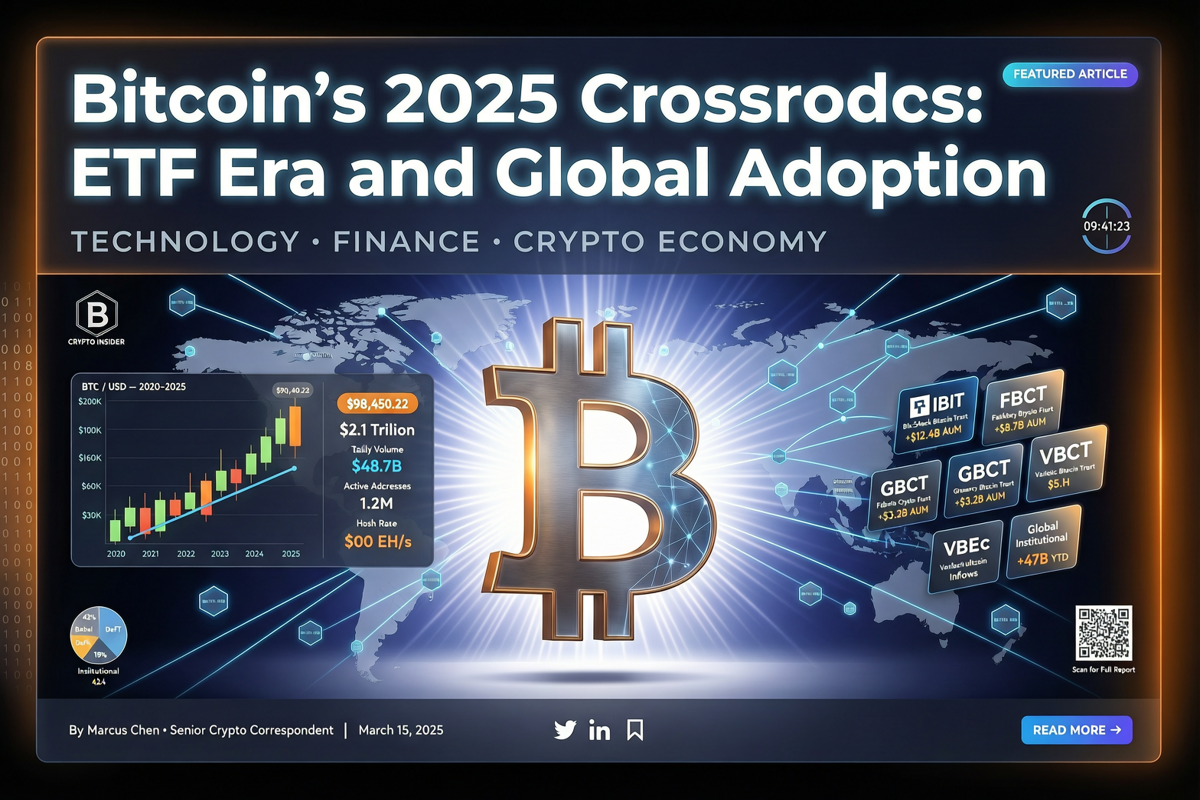
Bitcoin's 2025 Crossroads: ETF Era and Global Adoption
Explore Bitcoin in 2025: spot ETFs reshape markets, institutional adoption surges, and regulatory clarity drives a new phase of global cryptocurrency integration.
Bitcoin in 2025: A New Chapter Unfolds
Bitcoin, the world's first and most prominent cryptocurrency, enters 2025 at a pivotal moment. After a tumultuous 2022 and a recovery year in 2023, followed by the landmark approval of spot Bitcoin exchange-traded funds (ETFs) in the United States in early 2024, the digital asset has firmly entered the mainstream financial system. This article explores the key trends shaping Bitcoin in 2025: the impact of ETFs, institutional adoption, regulatory developments, and the evolving narrative of Bitcoin as both a store of value and a global payment network.
The Spot ETF Revolution
The approval of spot Bitcoin ETFs by the U.S. Securities and Exchange Commission in January 2024 was a watershed moment. Unlike futures-based ETFs, spot ETFs hold actual Bitcoin, providing investors with direct exposure without the complexities of self-custody. By 2025, these products have attracted tens of billions of dollars in net inflows, fundamentally altering Bitcoin's market structure.
Liquidity and Price Discovery
The ETF structure has deepened liquidity and improved price discovery. Bitcoin's daily trading volumes have surged, and the bid-ask spreads on major exchanges have narrowed. The presence of institutional custodians like Coinbase and Fidelity has also enhanced market integrity, reducing the risk of manipulation that once plagued the crypto space.
Impact on Volatility
Contrary to expectations, Bitcoin's volatility has not disappeared but has moderated. The 30-day annualized volatility, which historically exceeded 80%, has settled around 50-60% in 2025. This is still high compared to traditional assets but represents a significant maturation. The ETF mechanism allows for efficient arbitrage, smoothing out some of the wild price swings.
Institutional Adoption Accelerates
Beyond ETFs, direct institutional adoption has accelerated. Corporations, pension funds, and endowments are increasingly allocating a small percentage of their portfolios to Bitcoin as a hedge against inflation and a non-correlated asset. In 2025, several Fortune 500 companies have added Bitcoin to their treasury reserves, following the lead of MicroStrategy and Tesla.
Bitcoin as Collateral
A notable trend is the use of Bitcoin as collateral for loans. Major banks, including Goldman Sachs and BNY Mellon, now offer Bitcoin-backed lending services. This allows institutional holders to access liquidity without selling their Bitcoin, further integrating the asset into the traditional financial system.
Global Regulatory Landscape
Regulatory clarity has been a key driver of Bitcoin's 2025 trajectory. The European Union's Markets in Crypto-Assets (MiCA) regulation, fully implemented in 2024, provides a comprehensive framework for crypto assets. In the U.S., the SEC and Commodity Futures Trading Commission (CFTC) have established clearer jurisdictional lines, reducing legal uncertainty.
Emerging Markets Lead Adoption
In emerging economies, Bitcoin adoption is surging as a hedge against currency devaluation and capital controls. Countries like Nigeria, Turkey, and Argentina have seen record peer-to-peer trading volumes. El Salvador, which made Bitcoin legal tender in 2021, continues to integrate Bitcoin into its economy, though with mixed results. In 2025, several other nations are exploring similar moves, including Honduras and Paraguay.
The Scaling Debate: Layer 2 Solutions
Bitcoin's scalability remains a topic of intense debate. The Lightning Network, a layer-2 solution enabling instant, low-cost transactions, has seen significant growth. In 2025, Lightning Network capacity has surpassed 5,000 BTC, and major payment processors like Strike and Cash App have integrated it. However, concerns about centralization of Lightning nodes and routing inefficiencies persist.
Ordinals and Inscriptions
The emergence of Ordinals and inscriptions in 2023, which allow data to be embedded on satoshis, has sparked a new wave of innovation on the Bitcoin blockchain. In 2025, the Ordinals ecosystem has matured, with applications ranging from digital art to decentralized identity. Critics argue that inscriptions bloat the blockchain and increase fees, but proponents see it as a natural evolution of Bitcoin's utility.
Environmental Impact and Mining
Bitcoin mining's environmental footprint continues to be a concern, but the industry has made strides toward sustainability. In 2025, an estimated 60% of mining energy comes from renewable sources, up from 40% in 2023. The shift is driven by both regulatory pressure and economic incentives, as renewable energy becomes cheaper. Mining companies are also increasingly using stranded natural gas and hydroelectric power.
Mining Centralization
However, mining centralization remains a risk. The top three mining pools control over 50% of the network's hashrate. Efforts to decentralize mining, such as the Stratum V2 protocol, are gaining traction but have not yet achieved widespread adoption.
Bitcoin's Price Outlook
As of mid-2025, Bitcoin trades in the range of $80,000 to $120,000, having reached an all-time high of $150,000 in early 2025 before a correction. Analysts are divided on the short-term direction, with some citing the halving in 2024 as a bullish catalyst that will take time to fully materialize, while others warn of overvaluation and regulatory headwinds.
Macroeconomic Factors
Global macroeconomic conditions play a crucial role. With central banks in the U.S. and Europe signaling a pause in interest rate hikes, liquidity conditions are improving. Bitcoin's correlation with tech stocks has weakened, suggesting it is increasingly viewed as a distinct asset class.
The Road Ahead
Bitcoin in 2025 is no longer a fringe experiment. It has become a legitimate asset class with deep institutional involvement, clearer regulation, and growing utility. Yet challenges remain: scalability, energy use, and the risk of government crackdowns in certain jurisdictions. The next few years will determine whether Bitcoin can fulfill its promise as a global, decentralized digital currency or evolve primarily as a digital gold for institutional portfolios.
For investors and enthusiasts, 2025 is a year of cautious optimism. The ETF era has opened the door to mainstream adoption, but the journey is far from over. As always, due diligence and a long-term perspective are essential when navigating the volatile world of Bitcoin.