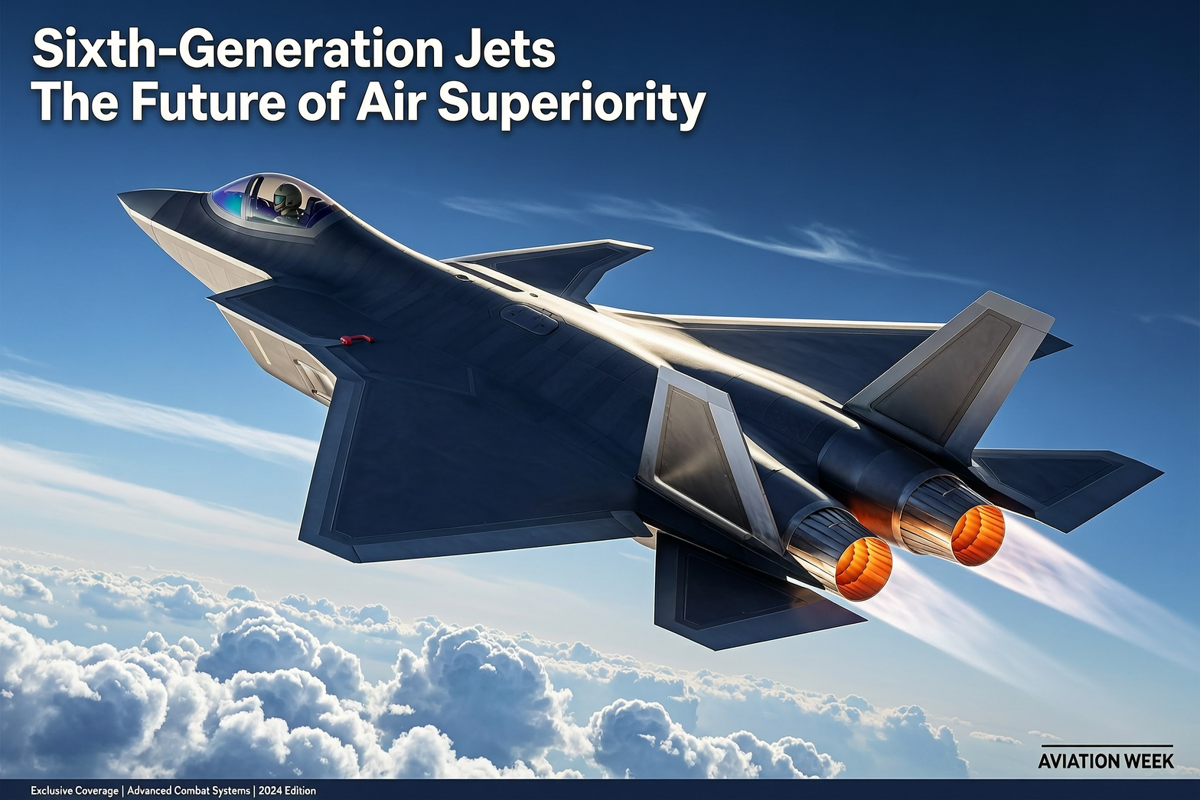
Sixth-Generation Jets: The Future of Air Superiority
Stealth, AI, and manned-unmanned teamwork are reshaping air force fleets. Explore how sixth-generation jets will dominate the skies for decades to come.
From Machine Guns to Microchips
When the first jet fighters took off in the 1940s, they were essentially propeller planes with new engines. Pilots still chased each other in visual range, relying on guns and guts. Seventy years later, the picture could not be more different. Modern air force jets are flying sensor platforms, packed with radar, electronic warfare gear, and data links that reach around the world. The transition from brute-force speed to information dominance is what defines the current era of military aviation.
Now a new generation is materialising. Called sixth-generation, these aircraft are not just upgrades. They represent a full rethink of what a fighter is, what it carries, and who—or what—does the thinking. Air forces that embrace this change will hold a critical edge in any future conflict.
The Generations of Jet Fighters
Jet fighters have developed in steps. First-generation jets like the Me 262 and F-86 brought swept wings and jet propulsion. Second-generation designs added radar and guided missiles. Third-generation types in the 1960s introduced supersonic dash and advanced avionics, but still relied on speed and agility. Fourth-generation fighters such as the F-16, F-15, and Su-27 combined fly-by-wire controls, pulse-Doppler radar, and beyond-visual-range missiles. They remain the backbone of many air forces today.
Fifth-generation fighters like the F-22 Raptor and F-35 took a different route: stealth. Their airframes, radar-absorbent coatings, and internal weapons bays made them nearly invisible to enemy radar. Stealth changed the calculus from "who climbs higher" to "who sees first and stays unseen." But even the F-35 is now two decades old. The see-saw of technology is already moving again.
What Makes a Jet "Sixth-Generation"?
There is no single official definition, but most analysts agree on several core pillars. The easiest way to think about a sixth-generation jet is as a "system of systems." It is not just a plane with a new silhouette; it is a networked node in a vast combat architecture.
Artificial Intelligence as a Copilot
Perhaps the biggest shift is the use of machine intelligence. Fifth-generation jets already process a lot of data, but humans still interpret it. Sixth-generation designs are built from the ground up to share the workload with onboard AI. The aircraft will fuse huge amounts of sensor data and suggest actions—or even take them autonomously in certain situations. That frees the pilot to focus on mission command rather than twiddling radar dials.
AI also supports the most hyped feature of sixth-gen planners: manned-unmanned teaming. The next jets are expected to fly alongside loyal wingman drones. Those drones can scout ahead, jam enemy radar, or fire missiles while the crewed plane stays safely in the rear. This is a dramatic departure from the classic solo fighter ace model.
Adaptive Engines and New Power
Another pillar is propulsion. Next-generation jet engines are designed to change their bypass ratio in flight, letting them cruise efficiently to the target, then ramp up fuel burn for a supersonic sprint. The third-generation adaptive engines under development by Pratt & Whitney and GE Aerospace promise significant range improvements—rumored to be up to 30 percent—and enough electrical power to feed directed-energy weapons like laser turrets.
Stealth, Redefined
Stealth remains vital, but it is now multi-spectral. A sixth-generation aircraft might be invisible not only to radar but also to infrared sensors, or even to the naked eye in certain conditions. However, stealth is no longer a blank check. Overhead satellites and networks of low-frequency radars are making classic stealth harder to guarantee. So designers are adding electronic warfare suites that can blind or fool sensors, rather than relying purely on shape and coating.
The Global Race for Next-Gen Fighters
The major aerospace powers are already spending billions to field sixth-generation jets in the 2030s.
America's NGAD
The United States Air Force is developing the Next Generation Air Dominance fighter, or NGAD. It is being built around a "digital engineering" process that allows rapid prototyping. The Navy has its own F/A-XX program. Both are expected to incorporate AI, adaptive engines, and drone companions. The Air Force had hoped to award a contract in 2024, though acquisition reviews and budget disputes have slowed the timeline.
Europe's Twin Tracks
In Europe, two separate projects are underway: FCAS (Future Combat Air System) among France, Germany, and Spain, and the Global Combat Air Tempest led by the UK, Italy, and Japan. Both aim for a sixth-gen fighter with a swarm of "wingmen" on either side. The fact that Europe is building two rival systems highlights the political complexity of defence collaboration.
China and Russia
China’s J-20 is often called a fifth-generation fighter, but reports suggest the next variant—the J-20B or a new J-XD—could incorporate sixth-gen features like adaptive engines and unmanned control. Russia’s Su-57 has faced production difficulties, but its futuristic "Checkmate" concept and MiG-41 plans show Moscow’s intention to stay in the race, although sanctions and technology gaps may limit progress.
Challenges Before Takeoff
There are plenty of obstacles between today’s blueprints and real operational jets.
- Cost. Each NGAD fighter could cost $300 million per airframe, far more than the F-35. R&D and sustainment will strain defence budgets. Some experts advocate for a mix of expensive high-end jets and cheaper attritable drones.
- Certification and trust. AI systems that can fire weapons have enormous ethical and legal implications. Military planners need to build fail-safes and human oversight into the software.
- Cybersecurity. A heavily networked aircraft is only as strong as its weakest link. If an enemy injects bad data into the data link, a sixth-gen fleet could be tricked into opening fire on nothing.
- Runway vulnerability. Next-gen fighters will still need prepared runways, unless air forces invest in short take-off and vertical landing designs. That is expensive and heavy.
The Pilot's Changing Role
If the sixth-generation jet seems more like a flying robot with a human attached, that is a fair read. The pilot is heading toward becoming a mission commander, or "combat manager," working with a team of unmanned assets from the cockpit. In the future, the crewed fighter might be only one component in a larger cloud of sensors and shooters. Many tasks will be delegated to algorithms, and the pilot's ability to reason ethically and apply judgement will become more precious than ever.
The era of the fiery-eyed fighter jock mixing it up in a rolling scissor is fading. In its place is a quieter but far more capable kind of air dominance—one where the winner of the next air war may be decided hours before weapons ever leave the rack, in the invisible battle over data and command.
As the world's air forces line up for sixth-generation programs, one thing is clear: the sky is becoming a computing environment, and the jets that rule it will be those that process information fastest, and turn that information into kinetic action with precision and restraint.