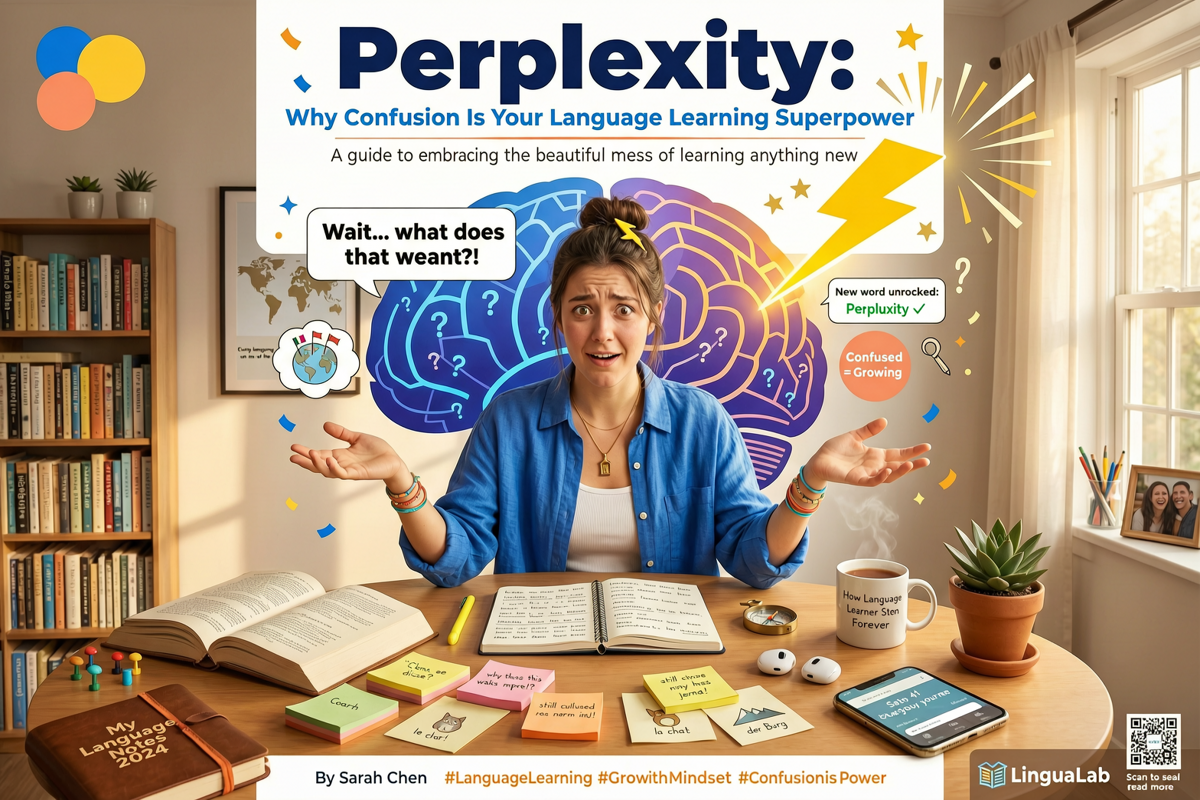
Perplexity: Why Confusion Is Your Language Learning Superpower
Perplexity in language learning feels like confusion, but it's actually the spark that fuels deep understanding. Here's how to harness it on your journey.
What Exactly Is Perplexity?
Imagine you are reading a novel in a foreign language and you encounter a sentence that seems to make no sense. Words you know suddenly rearrange into an unfamiliar pattern. Your forehead tightens. This is perplexity in action. In the field of language education, perplexity is often viewed as a nuisance, but research suggests it is a vital learning signal. When we feel perplexed, our brain is telling us that our current model of the language is incomplete—and that is exactly when learning happens.
To understand perplexity, we need to borrow a term from information theory. In computational linguistics, perplexity measures how well a probability model predicts a sample of text. If a model is confident about what the next word in a sentence will be, it has low perplexity. If it has to guess among many possibilities, perplexity is high. For human language learners, you can think of perplexity as the average number of possible words you consider when trying to predict what comes next. Beginner texts have low perplexity because they are predictable. Authentic native-level content can have very high perplexity because the options seem endless. This is why diving into a news article in your target language can feel overwhelming.
Why Perplexity Is Good for Your Brain
Psychologist Robert Bjork coined the term 'desirable difficulties' to describe learning challenges that actually strengthen memory. Perplexity is the perfect example. When your brain encounters an unexpected structure, it produces a small error signal. This signal triggers attention, working memory, and pattern matching. Research in second-language acquisition shows that learners who are pushed to understand challenging input just beyond their current level—Stephen Krashen's famous 'i+1' hypothesis—tend to progress faster than those who only read comfortable material. Perplexity is the engine of that progression. It forces you to construct new mental rules. Without it, you would simply plateau.
For instance, when a Spanish learner first encounters the subjunctive mood, the irregular verbs and mood shifts feel like chaos. But after struggling with examples, the brain builds a new pattern. The confusing phase is not a waste of time; it is the time when circuits are being rewired.
Five Ways to Turn Confusion into Progress
You don't need to seek maximum perplexity all the time. Instead, manage it so it helps, not hurts. Here are five evidence-inspired strategies.
- Sit with the discomfort. When you feel lost, resist the urge to immediately translate or look up every word. Give your brain 30 seconds to guess meaning from context. This trains your predictive circuits.
- Use anchoring. Identify a word or phrase you do understand in a confusing sentence and try to build meaning around it. This reduces cognitive load while preserving the challenge.
- Break it down. Analyze unfamiliar words for roots, prefixes, and suffixes. The Latin root 'spect' can help you guess 'inspect' and 'retrospect' even in a language you are learning.
- Vary difficulty. Aim for about 80 percent comprehensible input and 20 percent challenging content. This keeps perplexity in the sweet spot between boredom and frustration.
- Predict and check. Before reading further, guess what the next sentence will say. If you are wrong, your brain notes the mismatch and updates its model—this is learning.
A Teacher's Guide to Productive Perplexity
Educators can intentionally design lessons around perplexity. Instead of explaining a new grammar rule first, you can present example sentences and ask students to find the pattern. This small dose of confusion creates an information gap that motivates students to discover the rule. Richard M. Ryan and Edward Deci's self-determination theory tells us autonomy and competence are key motivators. When students struggle a bit and then succeed, their sense of competence jumps.
However, too much perplexity can trigger anxiety and shut down learning. Teachers should provide scaffolding such as pre-teaching vocabulary, using visuals, or giving hints. Formative assessments can identify where perplexity is too high. For instance, if most students fail a comprehension quiz, the input was likely too far above their level. Lower the bar slightly and restructure. The goal is not to eliminate confusion but to keep it manageable.
The Hidden Hand of Algorithms
If you have used a popular language-learning app, you have experienced the power of perplexity. Adaptive platforms analyze your answers and calculate how surprised a language model is by your mistakes. They then adjust the difficulty of new material. When the app throws a tricky sentence at you at the exact moment you feel comfortable, it is intentionally raising perplexity to promote retention. When you get a sequence of easy sentences, it might be lowering perplexity to build confidence.
This principle extends to AI tutors and speech recognition software. The next time you practice speaking and your app asks you to repeat a phrase you passed but mispronounced, remember: the system is using perplexity to find your learning edge.
Embrace the Fuzzy Logic of Learning
Perplexity is not a sign that you are failing at language learning. It is a sign that you are on the edge of a breakthrough. The feeling of confusion is your brain's way of signaling that your model of the language needs an update. By reframing that signal as an opportunity, you can turn frustration into fuel. So the next time you read something and say, 'I have no idea what this means,' pause. Smile. You are exactly where you need to be.