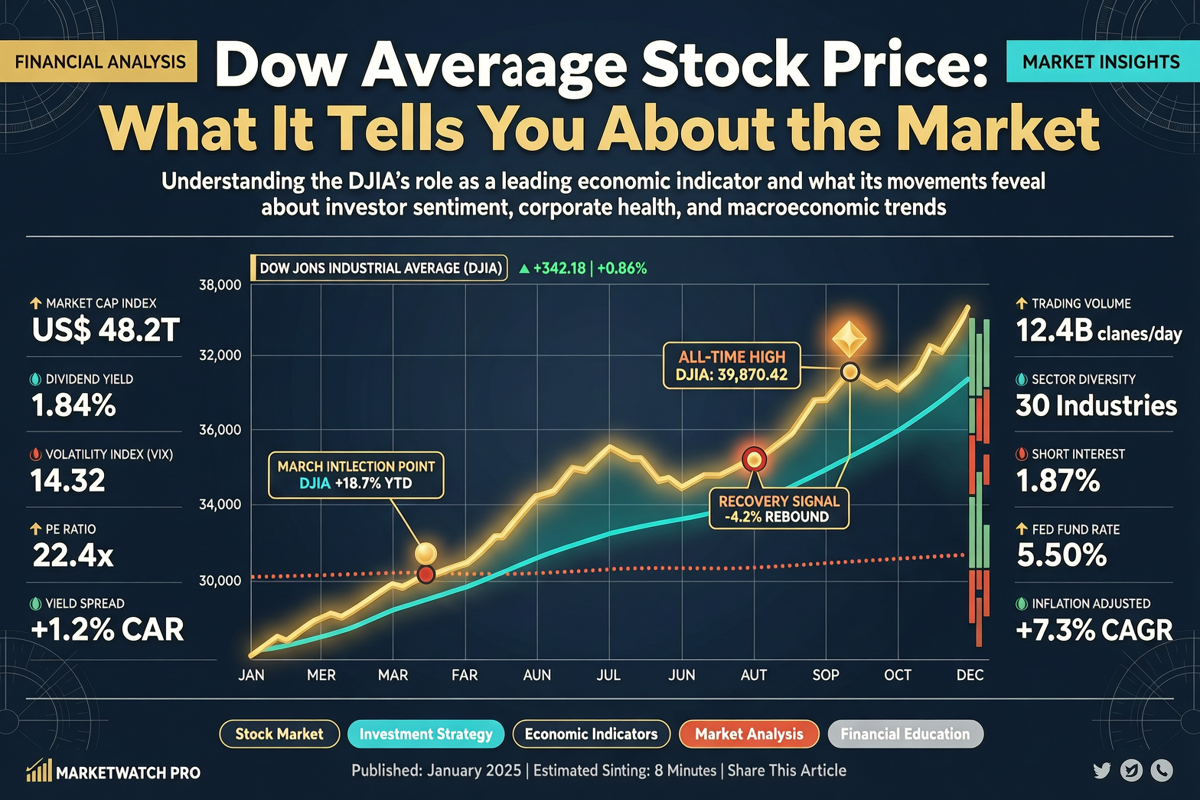
Dow Average Stock Price: What It Tells You About the Market
The Dow average is more than a number. Learn how this 30-stock index works, what its average price really means, and how to use it for smarter investing.
What Is the Dow Average?
The Dow average stock price, often simply called "the Dow," is one of the most widely followed stock market indicators in the world. Officially known as the Dow Jones Industrial Average (DJIA), it tracks the performance of 30 large publicly traded companies listed on U.S. stock exchanges. Investors, journalists, and everyday savers look to the Dow to gauge the overall health of the stock market and, by extension, the broader economy.
But despite its name, the Dow is not an average of every stock price on the market. Instead, it is a carefully curated index that represents a slice of American industry. The companies included range from technology giants like Apple and Microsoft to consumer brands like Coca-Cola and McDonald's, from financial institutions like Goldman Sachs to industrial mainstays like Caterpillar. This diversity is intentional: the Dow aims to reflect the state of different sectors of the U.S. economy.
When you hear a news anchor say "the Dow rose 200 points," they are referring to the change in this index's value. A point move in the Dow does not equal one dollar, nor does it represent the change in the average price of the 30 stocks. Instead, it is a weighted number calculated using a special formula that has changed over time.
How the Dow Average Is Calculated
Many people assume the Dow is simply the sum of the stock prices of its 30 component companies divided by 30. That was true in the late 19th century when Charles Dow first created the index. But over the decades, stock splits, mergers, and new additions have forced adjustments. Today, the Dow uses a price-weighted formula.
In a price-weighted index, companies with higher stock prices have a larger influence on the index's movements. For example, if a stock trading at $300 moves up 2%, that increases the Dow more than a stock trading at $30 moving up 2%, even though the percentage gain is the same. To account for historical events like stock splits, a divisor is used. This divisor is adjusted whenever one of the 30 companies splits its shares or undergoes structural changes. As a result, the Dow's level, such as 40,000 points, has little intuitive relationship to an actual dollar average of the component stocks.
The table below shows the current calculation approach in simple terms:
- Sum the latest prices of all 30 Dow stocks.
- Divide that sum by the current Dow divisor.
- The result is the Dow average stock price index value.
This methodology sets the Dow apart from other major indexes like the S&P 500, which is weighted by market capitalization. That difference matters: in the S&P 500, larger companies have more weight, while in the Dow, a $700 stock can move the index more than a $50 stock, regardless of company size.
Why the Dow Average Matters
Despite its quirks, the Dow remains a vital benchmark for investors and the public. Here are three key reasons it still commands attention:
- Historical significance: The Dow is the oldest U.S. stock market index, dating back to 1896. Its long history provides a century of data that analysts use to study market trends and economic cycles.
- Media and investor focus: Every business news outlet reports the Dow's daily moves. Because so many people watch it, the Dow can influence market sentiment and even drive trading behavior.
- Simplicity: The Dow's point movements are easy to grasp, even if the underlying math is complex. When investors hear "the Dow gained 500 points," they immediately understand that U.S. stocks had a strong day.
The Dow average also serves as a proxy for investor confidence. When the Dow climbs, it often signals that investors expect corporate profits to grow and the economy to expand. When it falls sharply, it may indicate fear about inflation, interest rates, or geopolitical instability. Policymakers, businesses, and consumers all pay attention to these signals.
A Closer Look at the 30 Components
The Dow's 30 member companies are chosen by the editors of The Wall Street Journal, not by a fixed rule. They aim to include leaders in major industries. As of 2025, the list includes familiar names such as Boeing, Disney, Home Depot, and Visa. Changes are rare and usually reflect a major shift in the U.S. economy. For instance, in recent years, the Dow added Salesforce and Amgen, while removing ExxonMobil and Raytheon Technologies. This constant evolution keeps the Dow relevant.
The Dow's Biggest Criticisms
Jack Bogle, the founder of Vanguard, was a famous critic of the Dow. He called it a "terrible" benchmark because of its price-weighting methodology. Let's examine the main criticisms:
- Price weighting distorts performance: A $1 move in a low-priced stock has the same effect as a $1 move in a high-priced stock, even though the low-priced stock's company may be much smaller. This lacks economic logic.
- Only 30 stocks are tracked: The U.S. stock market has thousands of publicly traded companies. The Dow ignores most of them, making it less representative than broader indexes like the S&P 500 or the Russell 3000.
- Overemphasis on a few sectors: Because the Dow includes only 30 companies, its sector composition can become skewed. For example, if the tech sector suffers, the Dow may drop sharply even if other parts of the market are doing well.
These criticisms are valid. But defenders of the Dow note that its longevity and simplicity have made it a cultural icon. For many retail investors, the Dow is their first introduction to the stock market. It demystifies finance and encourages broader participation in investing.
How to Use the Dow in Your Own Portfolio
If you are an individual investor, should you care about the Dow average stock price? The answer depends on how you invest. Here are a few practical ways to use the Dow without falling into its traps:
As a Market Barometer
Use the Dow to get a quick sense of market mood. If the Dow is climbing steadily, it usually indicates a bullish environment. If it is falling, caution may be warranted. However, do not make buy or sell decisions solely based on the Dow. Always look at other indicators, such as the S&P 500, the NASDAQ Composite, and bond yields.
As a Teaching Tool
The Dow's history is full of lessons about market volatility, compounding, and long-term growth. For example, it took decades for the Dow to reach its first 1,000 points in 1972. By contrast, it added thousands of points in a single year during the 2020s. This illustrates that market returns are not linear and that patience matters.
To Track Dividend Aristocrats
Many of the Dow's 30 companies are dividend-paying blue chips. So, when the Dow rises, you can indirectly track the health of some of America's most reliable dividend payers. For income-focused investors, the Dow can be a useful reference point for overall dividend market strength.
If you want to invest directly in the Dow, you can buy an exchange-traded fund (ETF) like the SPDR Dow Jones Industrial Average ETF (DIA). This fund aims to mirror the Dow's performance and lets you own a piece of all 30 companies in a single trade. That said, many financial advisors recommend broad-market index funds over Dow-based ETFs, as the broader funds offer more diversification at a lower cost.
The Bottom Line
The Dow average stock price remains a cornerstone of financial journalism and popular investing culture. It is not a perfect measure of the market, and it never will be. But it is still one of the quickest ways to see how the stock market is performing at a glance. By understanding what the Dow really tells you—and what it doesn't—you can make smarter decisions with your money.
Whether you are a seasoned investor or just starting out, the Dow deserves a place in your financial toolkit. Just remember to pair it with broader data, keep an eye on the long term, and never let a single day's point move dictate your strategy.