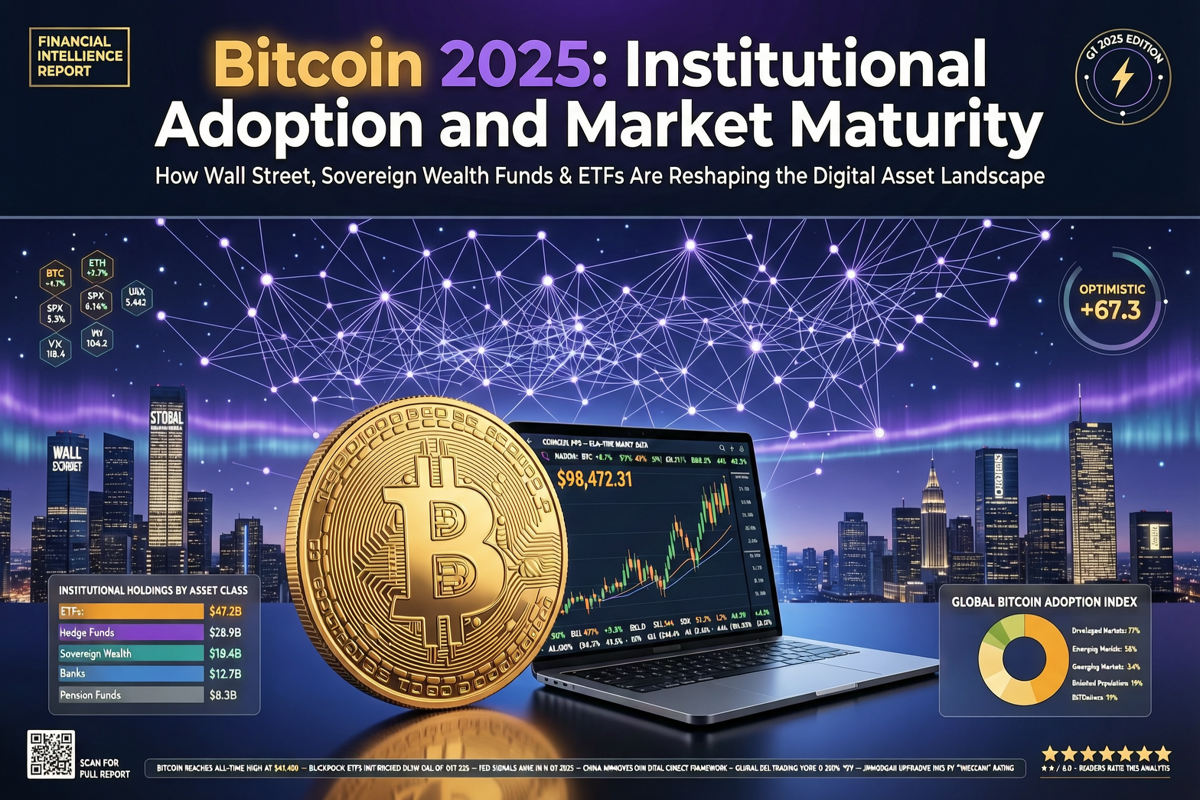
Bitcoin 2025: Institutional Adoption and Market Maturity
Explore Bitcoin's evolution in 2025: institutional inflows, regulatory clarity, and technological upgrades shaping the leading cryptocurrency's future.
Bitcoin Enters a New Era of Institutional Legitimacy
In 2025, Bitcoin is no longer just a speculative asset for retail traders. The cryptocurrency has firmly entered the mainstream financial system, driven by a wave of institutional adoption that began in the previous years. Major banks, hedge funds, and publicly traded companies now hold Bitcoin on their balance sheets, treating it as a legitimate store of value and a hedge against inflation. The approval of spot Bitcoin exchange-traded funds (ETFs) in several key markets, including the United States and Europe, has made it easier for traditional investors to gain exposure without the complexities of self-custody.
Regulatory Clarity: The Double-Edged Sword
Regulatory frameworks have matured significantly by 2025. The European Union's Markets in Crypto-Assets (MiCA) regulation provides a comprehensive legal structure, while the U.S. has finally passed the Digital Asset Market Integrity Act, clarifying the classification of Bitcoin as a commodity under the purview of the Commodity Futures Trading Commission (CFTC). This clarity has reduced legal uncertainty but also introduced stricter compliance requirements for exchanges and custodians. While some purists lament the departure from Bitcoin's cypherpunk roots, the regulatory embrace has opened the floodgates for pension funds and insurance companies to allocate a small percentage of their portfolios to Bitcoin.
Technological Upgrades: Scaling and Privacy
Bitcoin's underlying technology has not stood still. The Taproot upgrade, fully activated in 2024, has enabled more complex smart contracts and improved privacy using Schnorr signatures. Layer-2 solutions like the Lightning Network have seen explosive growth, with capacity exceeding 5,000 BTC and millions of channels active. This has made Bitcoin viable for everyday transactions, from buying coffee to cross-border remittances, with near-instant settlement and negligible fees. Additionally, the introduction of DLCs (Discreet Log Contracts) allows for trustless betting and derivatives on the Bitcoin blockchain, further expanding its utility.
Market Dynamics: Volatility and Correlation
Bitcoin's market behavior in 2025 shows a marked shift. While volatility remains higher than traditional assets, it has decreased significantly compared to previous cycles. The 30-day realized volatility now hovers around 40% annualized, down from 80%+ in 2020. Correlation with the S&P 500 has risen to 0.6, indicating that Bitcoin is increasingly treated as a risk-on asset rather than a digital gold uncorrelated with equities. However, during geopolitical crises, Bitcoin has often decoupled, acting as a safe haven for capital flight in countries with unstable currencies.
Mining Industry: Sustainability and Centralization
The mining sector has undergone a green revolution. By 2025, over 60% of Bitcoin's hash rate comes from renewable energy sources, driven by stranded energy projects and a shift toward hydro, solar, and wind power. However, concerns about centralization persist, with the top three mining pools controlling over 50% of the network's hash rate. The upcoming difficulty adjustment algorithm change, proposed in BIP-XXX, aims to mitigate this by penalizing pools that exceed a certain threshold.
Global Adoption: From El Salvador to Wall Street
El Salvador's experiment with Bitcoin as legal tender has inspired other nations. Several Central American and African countries have adopted Bitcoin for remittances and as a parallel currency. In Asia, Japan and Singapore have created regulatory sandboxes for Bitcoin-based financial products. Meanwhile, Wall Street has fully embraced Bitcoin: Goldman Sachs offers Bitcoin-backed loans, and Fidelity provides Bitcoin 401(k) options. The total market capitalization of Bitcoin has surpassed $3 trillion, representing about 50% of the entire crypto market.
Challenges Ahead: Scalability and Governance
Despite its progress, Bitcoin faces significant challenges. Scalability remains a concern, with the base layer limited to roughly 7 transactions per second. While Layer-2 solutions alleviate this, they introduce trust assumptions and complexity. Governance disputes over block size and protocol upgrades continue to simmer, though the community has shown resilience in reaching consensus. Additionally, quantum computing poses a long-term threat to Bitcoin's cryptographic security, prompting research into quantum-resistant signatures.
The Outlook for Bitcoin in 2025 and Beyond
Bitcoin in 2025 is a mature asset class with a clear regulatory framework, deep liquidity, and growing real-world use cases. While it may never fully replace fiat currency, its role as a digital reserve asset seems cemented. Investors should approach Bitcoin with a long-term perspective, understanding its volatility and the evolving landscape. As the saying goes, 'Don't invest more than you can afford to lose,' but for those with a high risk tolerance, Bitcoin remains one of the most compelling opportunities of the decade.